Friday, August 29, 2014

Gorgeous Prague

I have been told that Prague is a beautiful city, but accounts and pictures don't do it justice.

After a 6 hour train ride (sleeping most of the duration), I awoke to a hilly forested scene vastly different from the modern Berlin city I had just left.  The best way I have to describe Prague is a town that has been encroached upon by the 21st Century.  Old historic buildings make up the majority of the city, but shops have modernized small sections of each building.  The forested hills look as if out of a medieval time period, dotted with walls constructed in the 15th century.  However, a few modern buildings and cell towers rise from the lush green forest.  In addition, a gorgeous river runs through the center of the city and is spanned by both old and new bridges.  Above all of the city, sitting atop a hill is the crown jewel of Prague: the Prague Castle.
View of the crown jewel of Prague: Prague Castle.  The Charles Bridge is lit up next to it.

Old buildings encroached upon by the 21st Century.

View from the Charles Bridge.

View from the Charles Bridge overlooking Vltava River.

Prague was all rainbows!!
On my first day in Prague, I wandered the old town square and wandered into Petrin hill.  The old town square was packed with tourists and over priced souvenir shops.  However, given the tourist oriented nature of the square, there small side streets that were untouched by the gaudy tourists wares.  After crossing the Charles bridge, I wandered into some side streets; slowly making my way to Petrin hill and the Czech version of the Eiffel Tower.  Walking in Petrin hill was similar to walking through time.  Ivy laden stones, thickly forested paths, and deteriorating walls make for a gorgeous path up the hill.  At the top of the hill, the forest gives way to the Czech tower.  From this vantage point you can see the wonderful city of Prague.

Petrin Tower atop Petrin Hill.  From here you can see...

Prague and Rainbows!!!

With all the sites to see, it was difficult to get to all of them in one day.  As such, tomorrow I will go on a walking tour of Prague and try and visit the majority of the sites.

Thursday, August 28, 2014

Charlottenburg Palace and Stadium Sights

Today is my last day in Berlin and it was time to head to the outskirts of the city center.

Here on the outskirts of the city, my friend and I wandered back to the 17th and 18th century.  The Charlottenburg Palace was constructed as a summer palace for Queen Sophia Charlotte of the Prussian Kingdom.  It was built outside of the city to get away from the politics and bustle of city life.  Built in the French style and modeled after Versailles, the palace is situated on vast grounds that include a French and English style garden.  Although, the majority of the palace was destroyed in WWII, extensive renovations have restored the palace to as close as possible to its original form.  The most memorable parts of this palace are its half glass wall rotunda, the China Room, and it's personal church.  The glass rotunda has large windows that look out into the French designed gardens and has mirrors on the rotunda interior that reflect the exterior landscape and give the illusion of being in an open air rotunda.  Another significant portion of the palace is the China Room.  Queen Sophia loved to collect Chinaware and commissioned a room to be built for a palace extension to house this vast collection.  Unfortunately, she died before seeing the completion of the room, but according to her wishes the over 2000 piece collection became housed in the China Room.  The personal church is located adjacent to the China Room and against the teachings of the church is ornately decorated.  The church reflects Queen Sophia's interest in the arts.  (Lack of interior pictures was due to strict no photography policy)

The front entrance of the Charlottenburg Palace!


After wandering through the plethora of palace rooms, my friend and I walked through the palace gardens.  The gardens were built in a typical French style, but parts were converted to the English style.  Prominent sites include a personal harbor, a watchtower, and a mausoleum.

After seeing my friend off to the bus station, I still had time to visit the Berlin Stadium.  The stadium hosted three Olympic Games and hosts the championship for the Bundas League (the German country soccer tournament).


It was eerie to wander the grounds of the Stadium that was host to Olympic Games under the Third Reich.

After touring the Olympic Stadium it was time to head back and get ready for the trip to Prague.

Berlin Monument Course 2.0

After touring the classical monuments of Berlin, my friend and I headed to the modern parts of the city.  However, it was impossible not to stumble upon artifacts of the Berlin Wall and the old city.

Our first stop was the Bundestag, since we weren't able to enter the dome yesterday we showed up early to reserve our tickets.  Read my previous post if you want more information of the Bundestag.

After getting some great shots of the city, we headed through Grosser Tiergarten (large garden).  There we stumbled onto the Soviet War Memorial, commemorating the soldiers that died during the Battle of Berlin.  It was quite interesting to read the historical panels of the memorial.  A couple months after the Battle of Berlin the memorial was completed with a plaster statue.  It was some of newly constructed buildings in the post-war, bombed out Berlin and was a lone building in the flattened Berlin city.

The Soviet War Memorial features a statue of a Soviet soldier saying bye to his comrades.

The Soviet War Memorial also features the first T-34 tanks to arrive in Berlin.

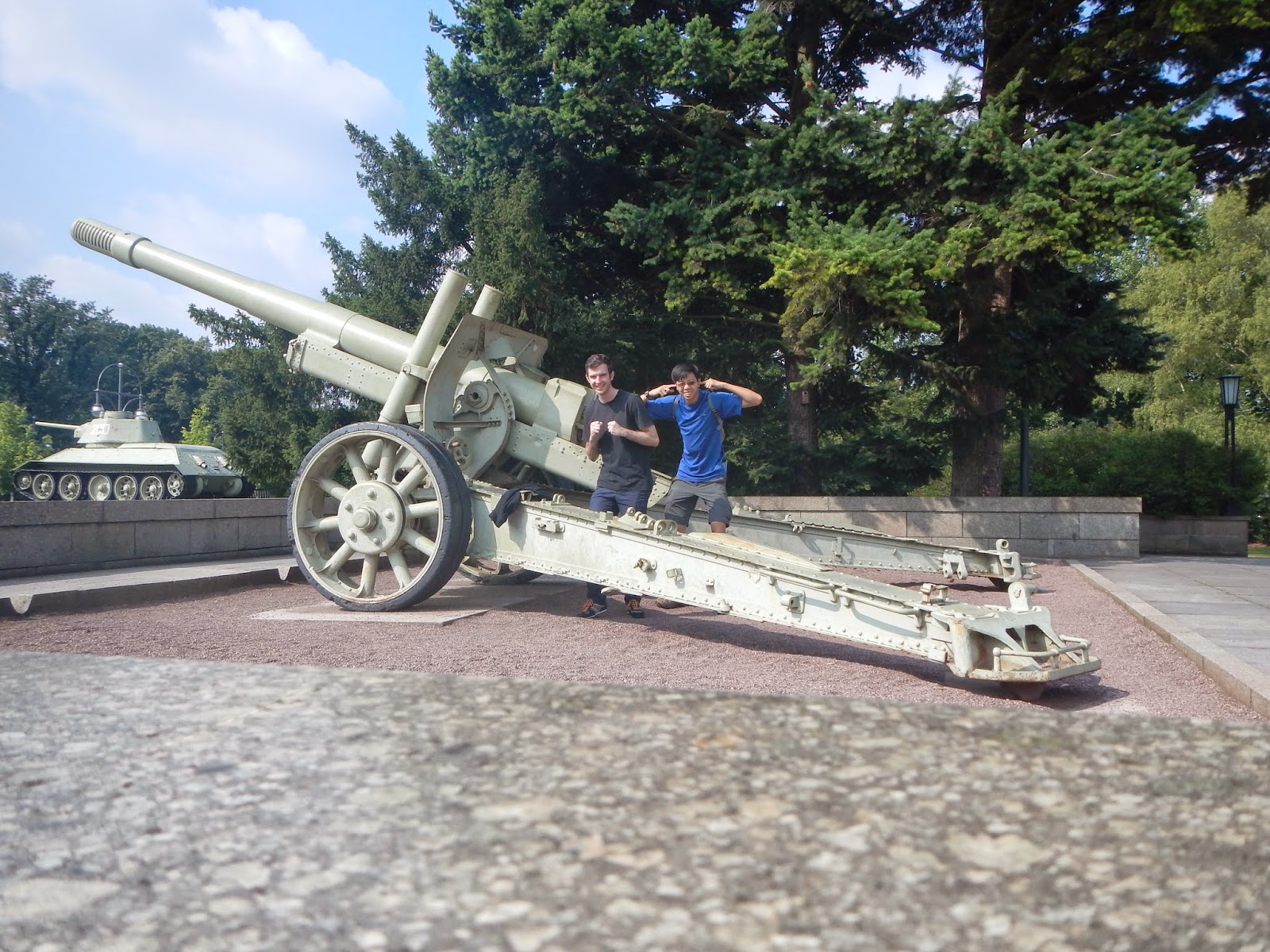
My friend and I pretending to fire the ML-20 152 mm gun-howitzer artillery.

After admiring the Soviet Memorial, it was crucial to get some Currywurst and so we viewed the massive Sony Complex, which serves as the Sony center for marketing and sales in the European region.  This location is known for it's many International movie premieres.
The Sony Center Complex.  This is a completely covered plaza where international movie premieres for Germany are often held.

Yum!  More currywurst; another stop in our extended search for the best currywurst in Berlin.

One train stop away is the Berlin Zoo.  It houses the largest number of species of any zoo and is a short walk from the only remaining church that survived the WWII bombings of Berlin.  While only a bombed out Bell Tower remains, it is flanked by a modern church with a blue glass facade running along the entirety of modern cathedral walls.

A reminder of the destruction of WWII.  The sole surviving church in Berlin, still didn't survive untouched.
Don't feed the rhinos at the Berlin Zoo.
 From this point, we took a short bus trip to see more of the Berlin Wall and Checkpoint Charlie.  Checkpoint Charlie was one of three crossings from East Germany to West Germany.  Nearby are panels detailing some of the bold attempts by people to flee East Germany and the Eastern Bloc.  Although nothing remains of the original Checkpoint Charlie, a replica of a guard house was built to memorialize the spot.  It is important to note that Checkpoint Charlie is a tourist trap.  While I appreciate the historical significance, it was merely a checkmark on the things to see in Berlin.

A picture of Checkpoint Charlie, before the wall fell.

A re-creation of a small guardhouse to memorialize the former Checkpoint Charlie.

The next stop was the iconic Victory Column.  This column was originally built by the Prussian King to commemorate the Prussian victory in the Danish-Prussian War, but by the time it was completed, it was a symbol for two other victories, the Prussian victory over Austria and France in the Austrian-Prussian War and Franco-Prussian War, respectively.  During WWII, the column was moved from it original location in front of the Bundestag to its current location.  From it current location, one can get an excellent view of the city of Berlin.

Victory Column in Berlin!

A statue of Victoria adorns the top of the tower.

Just a sample of the view from the Victory Column.


Tomorrow, we will head farther out of the city center to visit the Sophia Palace.

Thursday, August 14, 2014

Small Sampling of Berlin and The Search for Currywurst.

Berlin has such a rich history, especially within the 20th Century.  Today, my friend and I just scratched the surface of the historical sites.

After meeting my friend at the bus station, we headed straight to the television tower and then the DDR museum.  While the television tower was just a really tall tower, the DDR museum was an excellent peek into a communist state.  While East Berlin leaders had a little more flexibility with their decisions, due to their location near West Berlin, it seemed very representative of other communist countries.  The museum contained many artifacts from the Cold War era, which range from Travis, USSR produced car, to children's toys.  The museum also walks you through the secret police and the East Berlin country of terror.  Finally, gives a brief description of events leading to the fall of East Berlin and the collapse of the Berlin Wall.  I would definitely recommend the DDR museum to anybody visiting Berlin.

The DDR Museum!  This was just an advertisement.
Trying to change the tire on a Travis.  There were infamous for constantly breaking down.
 
My friend being interviewed by the Stasi.  This exhibit was really neat, you place your elbows two pads and it uses your bones to amplify a response.

Really close to the DDR museum is a place called Museum Island.  This is a UNESCO world heritage site and is home to the large collection of ancient artifacts.  A short walk from Museum Island is Brandenburg Tor (gate in German). During the walk, you can windowshop the various luxury stores or peruse the Willy Brandt museum.  This free museum documents the life of a Nobel Peace Price recipient, iconic German politician, and one of the driving forces of the Eurozone.  From the Willy Brandt museum you can see Brandenburg Tor.

View of one of the many museum buildings making up Museum Island.

Unfortunately there was major construction in and around Museum Island, so aesthetically it was not the prettiest place.
 This iconic symbol was built on the 1700s as a symbol for peace, but became a triumphal arc during the Prussian occupation.  At this point, the iconic statue of Victoria was placed atop the gate.  The area around Brandenburg Tor is where the majority of the foreign embassies are located.  This makes sense given the proximity of the Brandenburg Tor to the Bundestag (the German parliamentary building).

Brandenburg Tor

The Bundestag has been in use since the 1st Reich.  It was constructed prior to WWI and had undergone many reformations.  After the initial building, a phrase meaning "For the German People" was added after WWI.  During the establishment of the Third Reich, rival parties to the Nazi's burned the dome in protest .  During WWII, it suffered heavy damage as a result of bombing and during the siege of Berlin by the Soviets.  After WWII, it was renovated and during the Cold War it resided on the West Berlin side of the Berlin Wall.  After the fall of the USSR,  a new dome was constructed from glass to direct light into a plenary chamber below, where the German Parliament currently debates le legislation.  Given its rich history, this is a must see sight.  However, make sure to get there early to make reservations for entrance into the Bundestag Dome.
Outside of the Bundestag, if you look closely you can make out the German phrase meaning "For the German People".

View of the Dome on top of the Bundestag.  The glass dome, lets in natural light and adds to the carbon neutral qualification of the building.

This mirrored spire reflects sunlight into the plenary chamber.
After touring the Bundestag Dome, my friend and I took a walk to the modern buildings that house the offices of parliamentary members and the German Chancellor.  The architecture of the two buildings that make up the complex is supposed to represent the unification of East Berlin and West Berlin.

Offices of the parliamentary representatives.

House of the German Chancellor.  Is Angela Merkel home?
 After touring the sites (we didn't even get all of them), my friend and I went on an epic hunt for the best Currywurst in Berlin.  Currywurst is a modern Berlin street food that has since spread across Germany, which consists of a sliced sausage (typically bratwurst) covered in a tomato sauce and curry powder.  I would highly recommend trying the dish, since it is relatively cheap and nice to eat at a park.

Currywurst; in all its street food glory.

On our stay in Berlin, we took multiple trains to find the three best locations for Currywurst.  We were comparing the Berlin Currywurst to the Currywurst in Western Germany.  Unfortunately, we never came close to finding a Berlin Currywurst that compared to Currywurst from Western Germany.  Not a bad thing, but I prefer Western German Currywurst to Berlin Currywurst.

Tomorrow, we will hit more sites of Berlin.  Stay tuned!

Monday, August 11, 2014

A Berlin Welcome

Today I headed to Berlin on an early train from Amsterdam.  After arriving in Berlin the first thing I noticed was the modern train station.  While many European countries will use an existing building and convert it into a train station, Berlin has a three story train center.

View of the three story train station.  The station symbolizes the very modern city of Berlin.

 This is one thing that I noticed when walking around Berlin.  Due to WWII and subsequently the Berlin Wall, Berlin does not have the narrow streets of traditional historic cities.  Most streets are three lanes wide and all the buildings are very modern.  It is a city reborn from the ashes of both fascism and communism.

There are no narrow cobblestones streets here in Berlin.

However, there has been a large effort to restore and maintain historical buildings.  On my first day, I visited the East Side Galleria, which is a part of the Berlin Wall that has been converted into a mural art museum.  It was fascinating to see the different messages each artist decided to depict with their small section of the Berlin Wall.

The East Side Galleria is a very long section of the Berlin Wall preserved as an mural gallery.

If only East and West Berlin had such a cozy relationship, things might have been different.

All the cities with walls, and what a world with walls does to the people.

Me and the Berlin Wall.  I was not alive to see it fall, but can appreciate the historical and cultural significance.


I really like this mural; an interesting take on Picasso's La Guernica.


Tomorrow, I will meet a friend from
Germany and explore more of the city.  Stay tuned!

Tuesday, August 5, 2014

Planes, Trains, and Amsterdam

Disclaimer: This blogpost is rated PG-13 for drug references (only a few).

Today was all about traveling on 4 hours of sleep.  I believe the only thing that was keeping me going was pure adrenaline and wonderment.  What I know for sure is that I am extremely exhausted and won't have a problem getting to bed tonight.

After one plane ride and two train rides, I was in Amsterdam (thus the name of the blogpost).  When I was planning my trip to Amsterdam the first thing that came to mind were the coffeeshops, where patrons indulge on two types of substances, and the red light district.  Due to my ignorance, I thought those were the only things to see and since I wasn't interested in either I only planned for one night.  Needless to say, I wish I had more than one afternoon to see Amsterdam.

View of the Amsterdam train station upon my arrival.


While I was walking around Amsterdam, there were so many little nooks and crannies that I wish I had time to discover.  On the surface, Amsterdam is like any bustling city, but when you look closely, it has a character all its own.

The first thing that you notice are all the modes of transportation.  People in this city are getting places almost all ways imagineable, except for flying cars.  In the streets, there are specialized bike, pedestrian, automobile, and tram lanes.  If you aren't careful, you will probably get honked or ringed (as in bell ringing) for being in the wrong lane.  However, if you don't like travelling the streets, try the vast network of canals that run through the city.  You can travel by paddleboat or motorized boat, and don't worry about your boat being too tall, the Dutch traffic engineers have taken this into account by installing a multitude of raised bridges and drawbridges.

One of the many different crazy intersections in Amsterdam.  Can you tell which lane is for which mode of transportation?
One of the many drawbridges that allow boats free reign of the canals.

Another thing that I noticed about Amsterdam are the sleepy little boroughs outside of the beaten path.  Even on a Monday, the Dutch are biking around their own neighborhoods saying hi to the occasional friend, sitting in the many cafes, enjoying the occasional beer, lounging in the park, or people watching by the many canals.  They also live on the canal, houseboats line the network of canals outside of central Amsterdam.  Each of the houseboats are like townhomes; each with their own style and character.
A typical look of the canals around Amsterdam.  In the background you can see some of the many houseboats.
Of course there are also some big tourist spots, which include the Van Gogh museum, Vondel Park, the Royal Palace, the Flower Market, the Anne Frank House, the Tulip Museum, the Houseboat museum, the National Maritime Museum, and various cathedrals that maintain their hipness by ringing their bells in familiar tunes.

View of the Van Gogh Museum; such an interesting design.

Part of the flower market.  Unfortunately, tulip season was over so the only things left were the bulbs.
View of the Royal Palace.  Unfortunately, I did not have time to visit the interior.

Amsterdam has been far more than I expected and I wish I had longer to explore.  However, I am off to Berlin to explore the rich culture of Germany.

View of the train station on the day of my departure.  I wish I had more time Amsterdam.